
I finally built Mudu, an end-to-end encrypted private space for couples, families and close friends.
Probably all of us have some kind of list. A list of things we want to build. A list of things we want to try. A list of places we want to see. A list of ideas that keep coming back once in a while, but somehow never quite become the next thing.
One of my favorite lists is the one where I keep ideas that excite me. Every now and then I come back to it. Some ideas already feel like they belonged to a different version of me. Others still pull me in.
For years, one of those ideas was a home for the little bits of shared life that do not really belong anywhere else.
Not a calendar. Not a notes app. Not a task manager. Not another place to optimize everything until it becomes joyless. More like a quiet corner for plans, memories, feelings, places and all the tiny things that make a relationship feel alive.
For a long time I kept dismissing it. It would take too much time. It would not make sense without Android. It would need a backend, end-to-end encryption and solid sync. The scope would probably explode. Every reason felt reasonable enough to leave it alone for a bit longer.
But then the question became very obvious: if not now, then when? Do I really want this idea to stay another decade on the list of things I really want to build but keep finding excuses not to?
The answer was clear. I had to build Mudu, a private app for couples, families and close friends. A shared space for the small things that help people feel closer, more understood and more connected.
Even the app name was clear to me from the beginning. It comes from the Lithuanian word “mùdu”, which roughly means “the two of us”. To me, that is the whole idea. A private space built around closeness.
Idea


The core idea was simple: use technology to help people hold onto the small things that make them feel close.
That can sound a bit abstract, but in practice it means very small things. A plan you both keep returning to. A place one of you wants to visit someday. A list that slowly becomes a record of your shared life. A moment that should not be lost. A small way to say how you feel when saying it directly feels harder than it should.
None of this is impossible with existing technology. In fact, shared Apple Notes did most of this for me for a while. It was hacky and sometimes awkward, but it worked. I still remember the small excitement of adding a new shared plan, a bucket list item or some silly idea into that shared chest.
It felt magical in a very simple way. Not because the tool was special, but because the act itself was. There is something quite warm about having a tiny shared place where future plans and half-formed ideas can live before they become real.
Ever since then, I wanted to bring those concepts into a dedicated app. But I did not want to just put shared fun stuff into an app and call it a day. I wanted to push it a bit further. I wanted to build a set of tools that could help people build stronger and healthier relationships.
- Something that helps you express how you feel.
- Something that helps resolve friction in a calmer way.
- Something that makes small shared plans easier to hold.
- Something that feels personal instead of transactional.
And on top of all that, the most important requirement was privacy.
Everything had to be encrypted. There was no version of this app where I would feel comfortable asking people to put intimate relationship context into it while the app quietly treats that data as something to collect.
I wanted Mudu to be the kind of app where, if you knew exactly how it worked, you would feel calmer, not worse. Nothing creepy. Nothing weird. Nothing that would make me feel like I betrayed the idea or the people using it.
That is where Mudu started to take shape.
Shape
Turning the idea into an actual app was harder than expected.
There were too many ideas. Way too many for an MVP. Every note had another note attached to it. Every feature had three different versions. And every simple thing became less simple once privacy, encryption and sync entered the room.
After many iterations, I decided to split Mudu into a few core parts:
- Signals: share emotional and intimate states with less friction
- Places: save places, plan trips and make the world feel like something you are exploring together
- Lists: keep shared plans, bucket lists, tiny tasks and long-running context in one place
- Moments: remember important dates, memories, anniversaries and the small events that matter
- Tools: lower emotional load and make small decisions or hard conversations a bit easier
That structure made the app feel possible. Not small exactly, but contained enough that each part had a clear reason to exist.
Signals
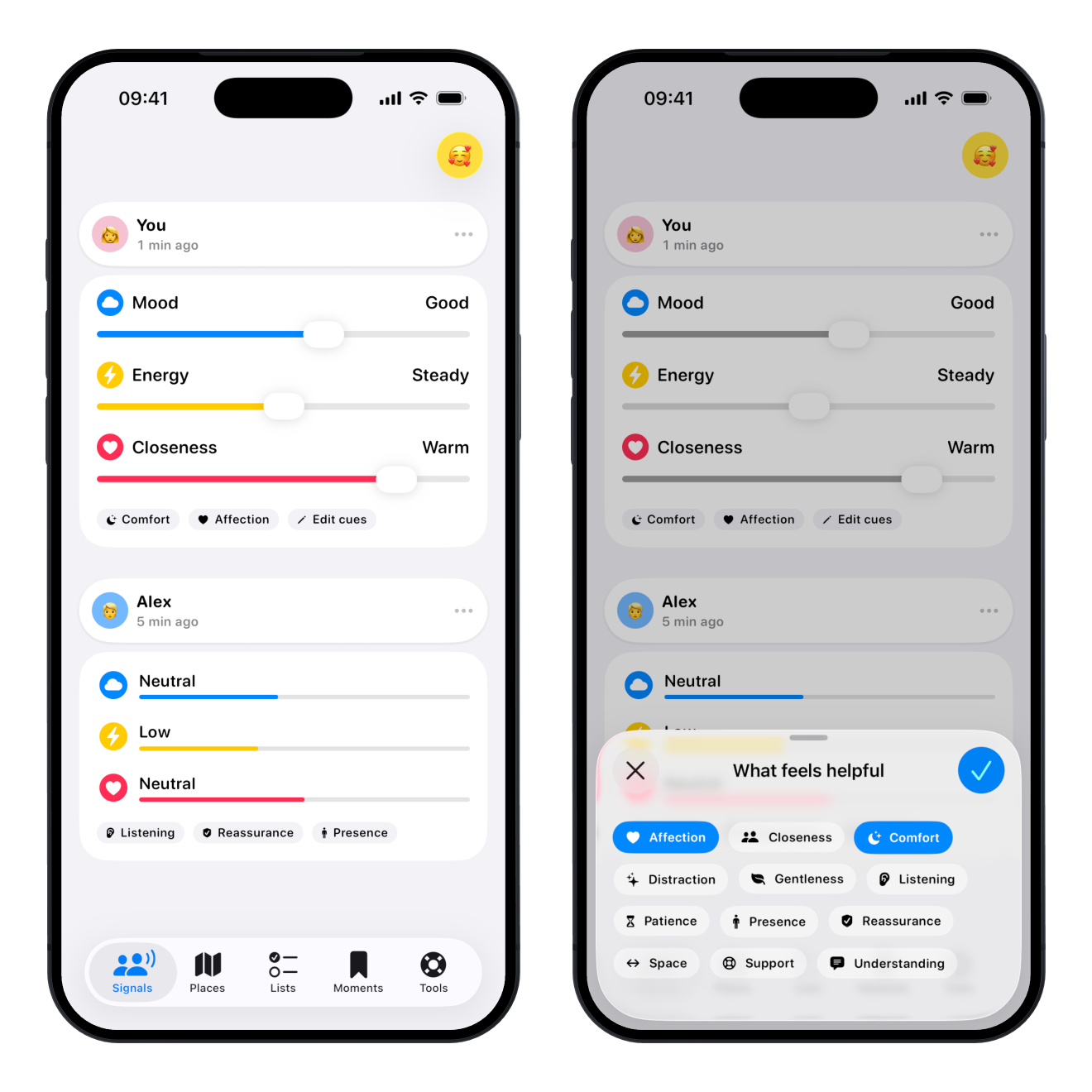
Every person is different. That does not sound surprising or controversial, but it becomes very real inside a relationship.
We all have needs, but we do not all communicate them in the same way. Some people can say exactly what they feel. Some people need time. Some people only realize what they needed after the moment has already passed.
Some people can read the room very well. Others need a clearer signal.
Mudu Signals are for that space in between. For the person who knows something is off but does not yet have the words. And for the person on the other side who cares, but does not always know what to notice.
I believe it takes time and effort to read and understand each other. I also believe that no digital tool can replace real conversations, deep listening and patience.
Signals are not meant to replace those things.
They are meant to be a starting point. A small bridge. A way to say “this is where I am right now” without needing to turn every feeling into a full conversation immediately.
Sometimes that is enough to soften the moment. Sometimes it creates just enough understanding for a better conversation later.
Places
I love traveling.
This is probably why travel-related features received so much attention in Mudu.
For me, there is something magical about putting an itinerary together and then checking it one item at a time. Even coming back to an old itinerary years later can bring back warm memories.
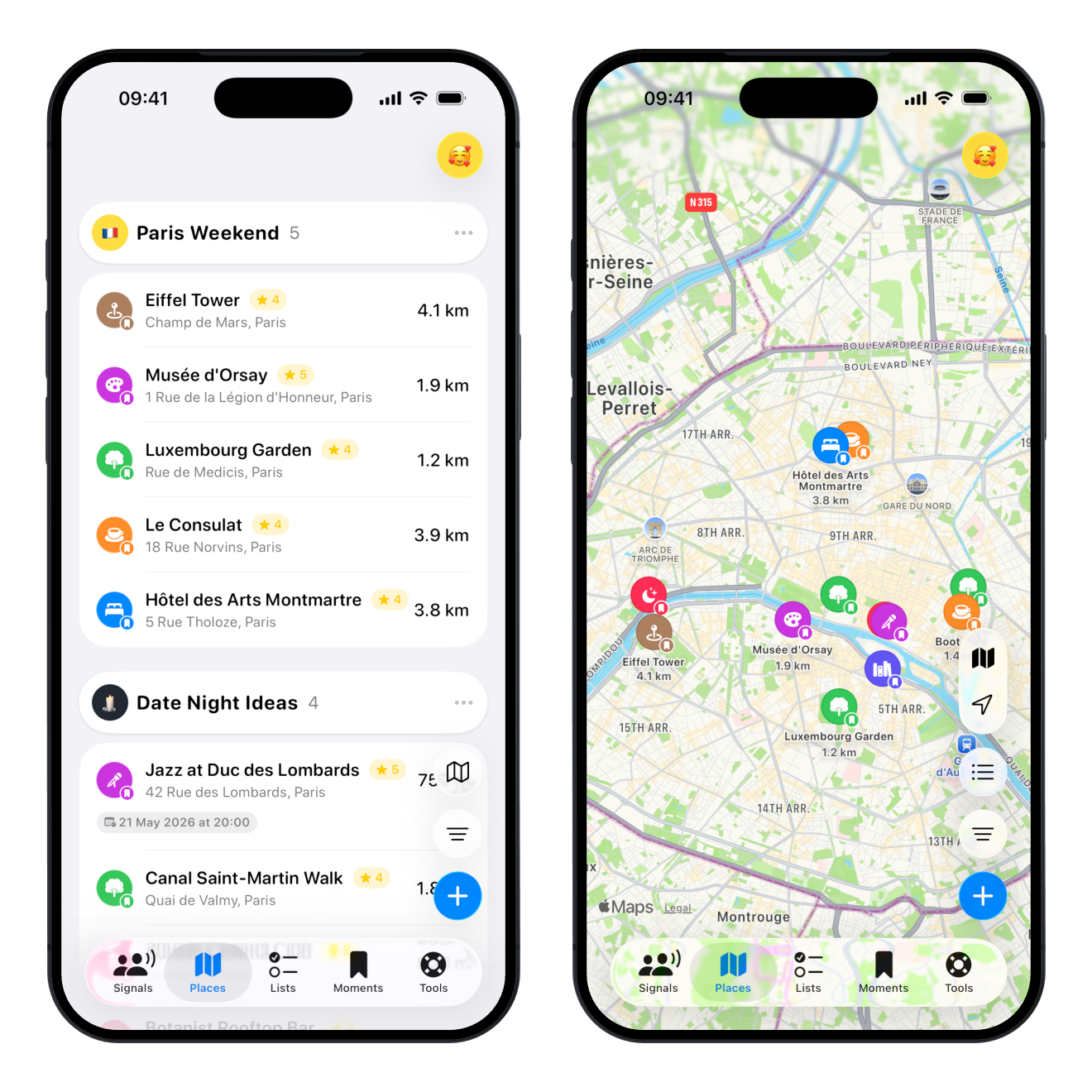
The main idea behind Places is simple: keep the places you want to experience together.
It does not have to be a complicated trip. In fact, a big part of it is for casual everyday life. You or your partner adds a place you want to visit someday. Then one day you are walking nearby and the app reminds you that this place exists. Without that small reminder, you would probably just pass by.
Or maybe your partner really wants to go to a specific restaurant. They add it to the map. Then your anniversary comes and you are thinking where to go. Suddenly the choice becomes easier, and also more meaningful, because it came from something they already cared about.
You can also create a solo space and keep places only for yourself. That works well for solo trips, but also for surprises that should remain surprises until the right time.
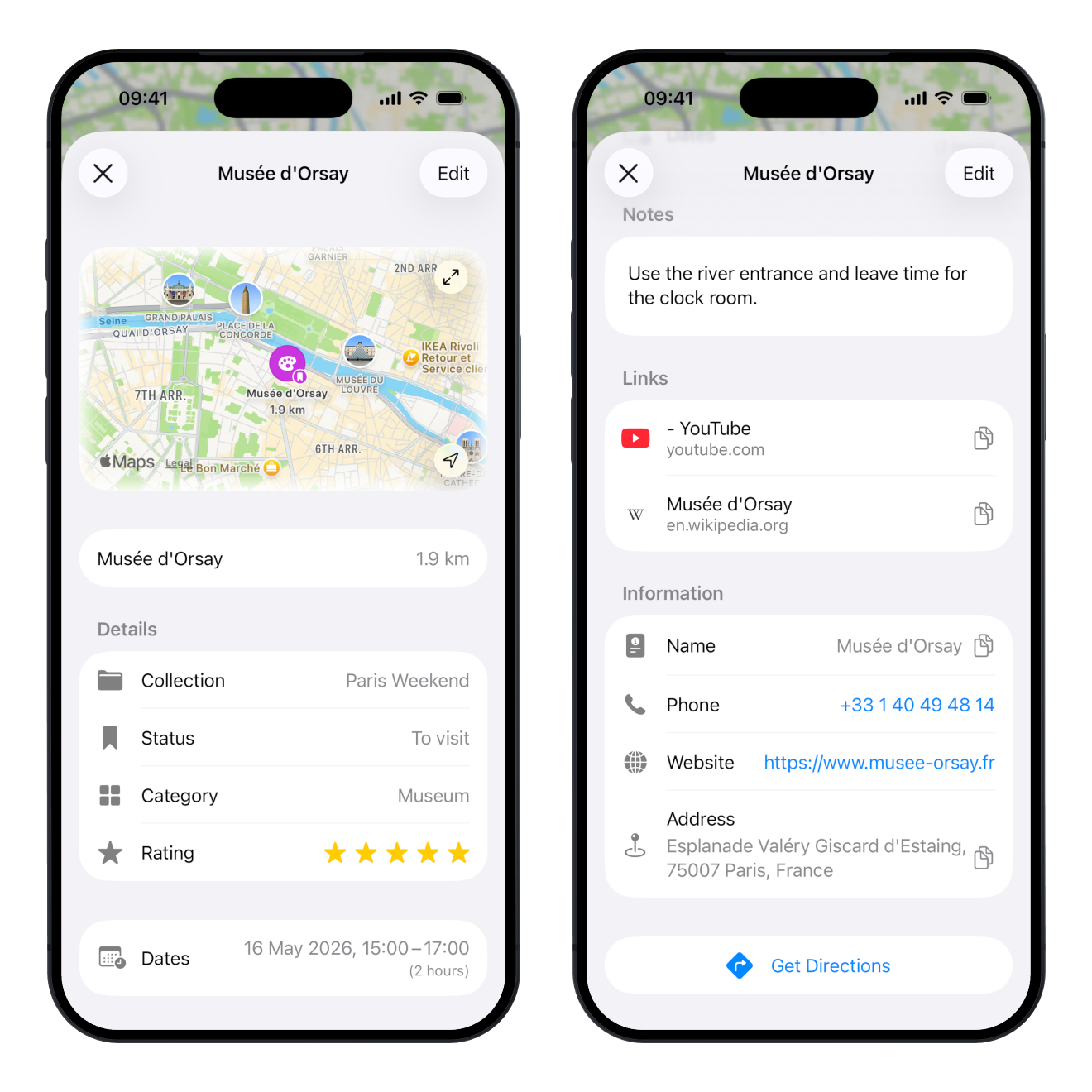
For people who love sentimental details, each place can have notes, ratings and other metadata. Not just “we went here”, but “this is what it meant”.
And for people who do not care about the sentimental side at all, Places still works as a practical travel helper. Each place can have dedicated dates, travel documents, links, reminders, routes in your favorite navigation app and useful automatic metadata like phone numbers, websites and distances.
It can be emotional or practical. Ideally, both.
Lists
I do not think it will surprise anyone who knows me that I like lists.
Over the years I created quite a few of them and still maintain many to this day: favorite movies, blog post ideas, books, WWDC backlog, experiences to try, things to see and probably too many others.
For some reason these lists feel cozy to me. They have a past that feels sentimental and a future that feels exciting.
But shared lists are something else.
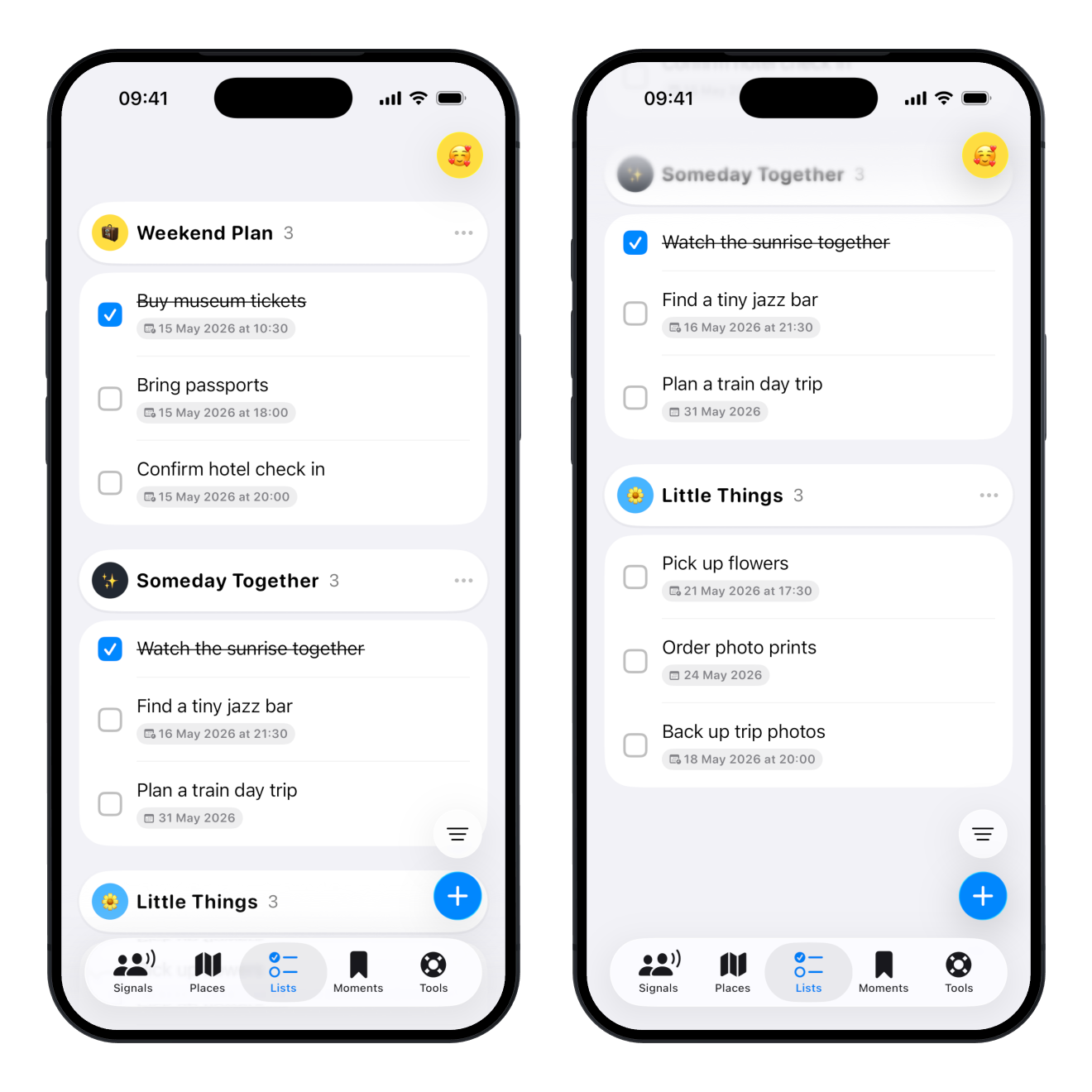
There is a very specific feeling in adding shared bucket list items and then completing them together. They slowly become a record of tiny promises to the future. Some silly, some serious, and some unexpectedly important once you actually do them.
And then there are all the other lists that quietly hold shared life together. Things you want to cook together. Movies you keep postponing. Gift ideas. Future trips. House things. Restaurants. Inside jokes. Small plans that would otherwise disappear into the void.
Of course, lists do not have to be exciting. They can be as boring and useful as needed. Groceries. Packing. Tasks before a trip. Things to buy. Things to fix. Things to remember.
The point is not that every list has to be meaningful. The point is that shared life creates shared context, and shared context needs somewhere to live.
And again, shared does not always need to mean shared with another person. You can have a solo space where things are only relevant to you. In that case they are shared between your own devices while still being end-to-end encrypted.
Moments
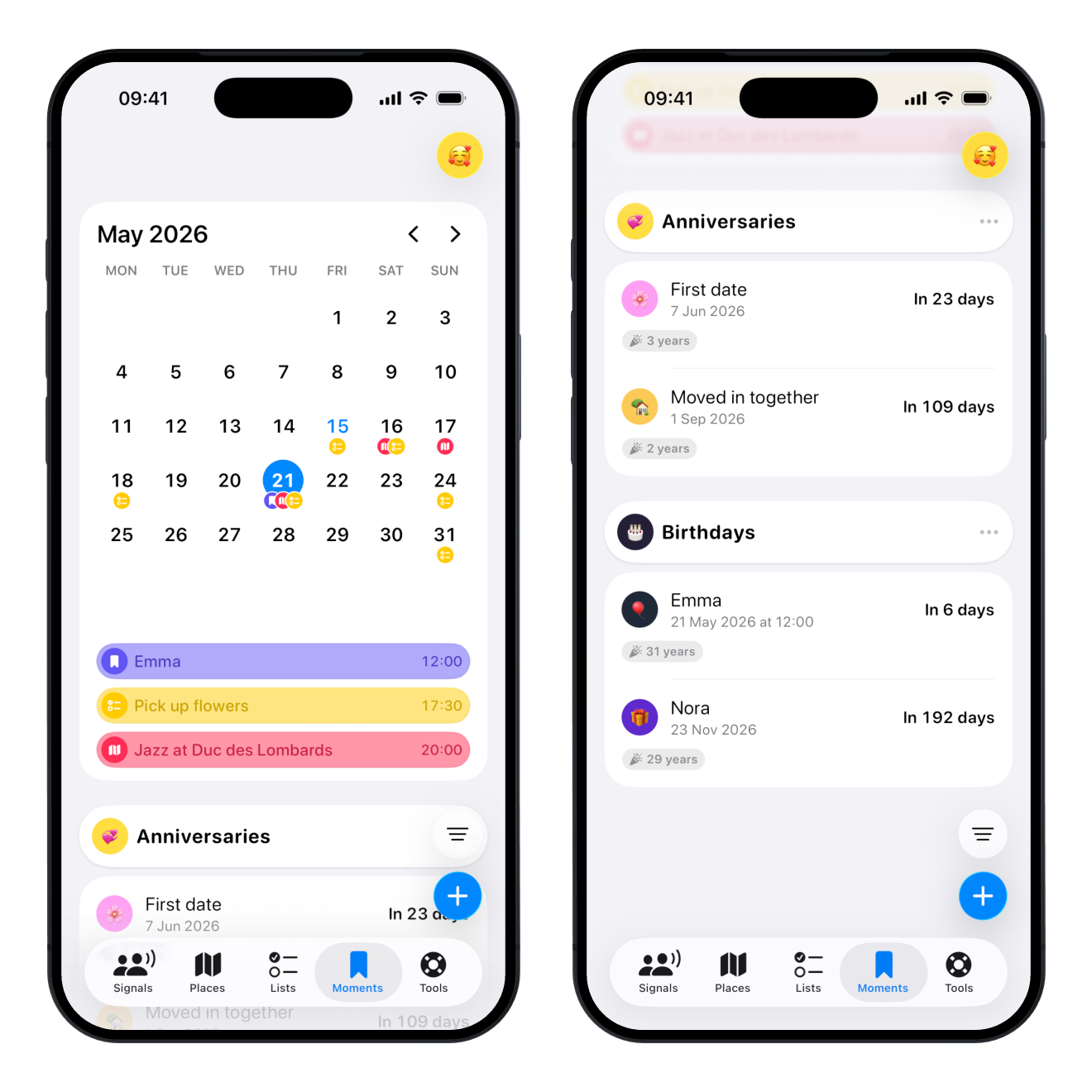
Moments is where the sentimental part of me lives.
It is kind of funny to think about, but one of the first apps I released on the App Store was also about memories. More than ten years later, my idea of what a good memory app should be has changed quite a bit, but the goal is still very similar.
Something important happened? Add it to Moments.
Feels like there is more to the story? Add notes.
Is it an important event? Add a reminder.
Should it come back every year? Add recurrence.
Is it something you are waiting for? Add an anniversary and count the days with some excitement.
I like this kind of memory keeping because it does not ask every moment to become some big story. Sometimes a date, a note and a small reminder are enough.
Not every important thing needs to be turned into social media content. Some things just need a quiet place where they can live.
Moments is that place in Mudu.
It also ties other parts of the app together. You can have an overview of places, lists and moments in one place, which becomes especially useful when traveling. It gives you a way to see your itinerary, todos and contextual details without jumping between many different apps.
Tools
Tools is probably one of the most exciting parts of Mudu for me.
This is where the app can do a bit more than store shared context. Not by forcing anything or pretending to solve relationships, but by making some hard moments a little easier to enter.
The goals are simple:
- reduce friction
- lower emotional load
- encourage positive interaction without forcing it
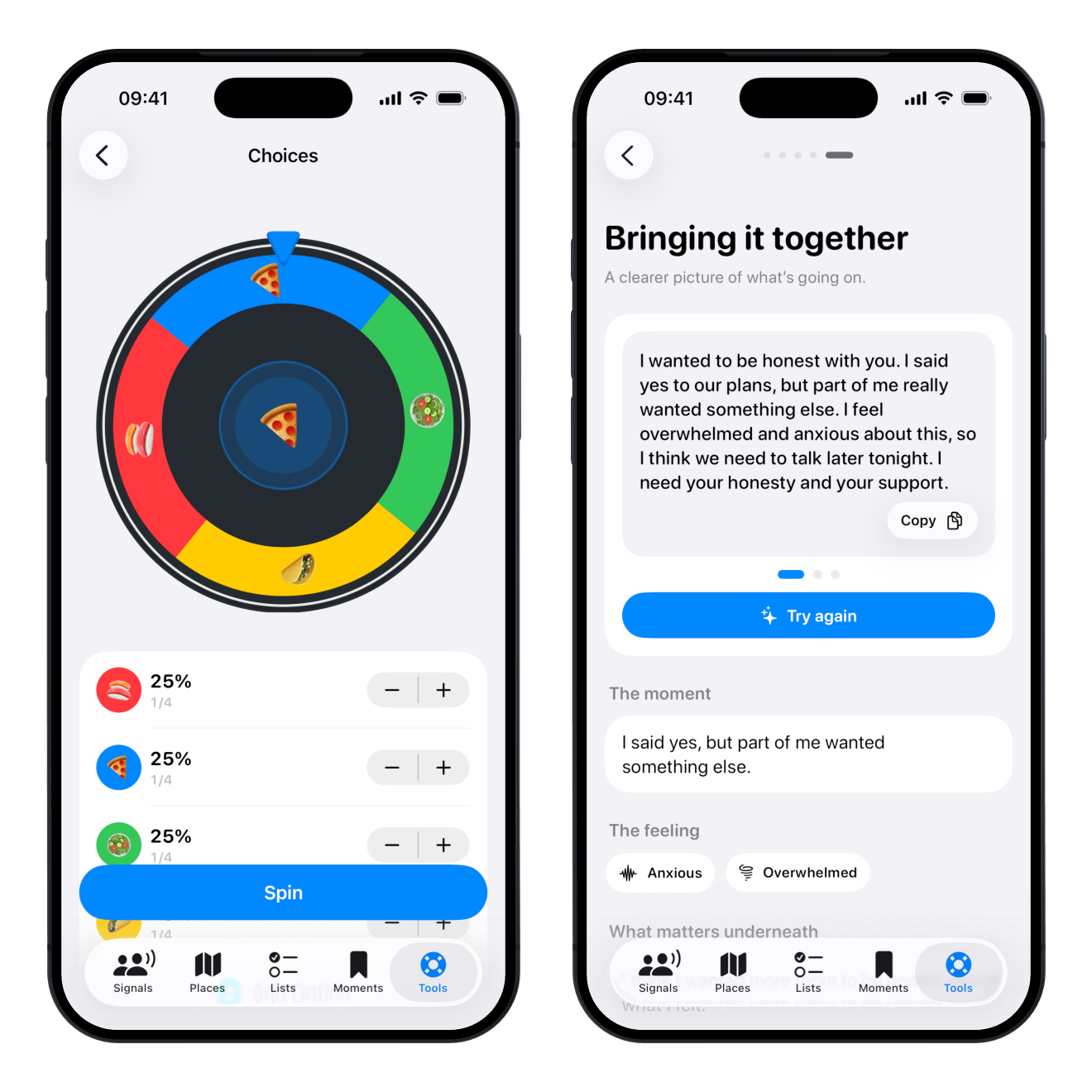
The first tool is called Clarity, and the idea is exactly that: help you get a little more clear before you speak, share or react.
Clarity helps you reflect on what happened, understand what matters underneath the feeling and turn that into clearer words or a more useful signal.
It starts with a simple flow that gathers the most relevant input. The goal is not to overcomplicate the moment, but to help you slow down enough to understand what is actually going on.
At the end, it gives you an overview and a few possible next steps. You can turn it into a signal inside Mudu, or create a short conversation starter that helps you express the important part more clearly.
Keeping with the privacy theme, this uses an on-device language model. Your personal relationship context does not leave your device for this.
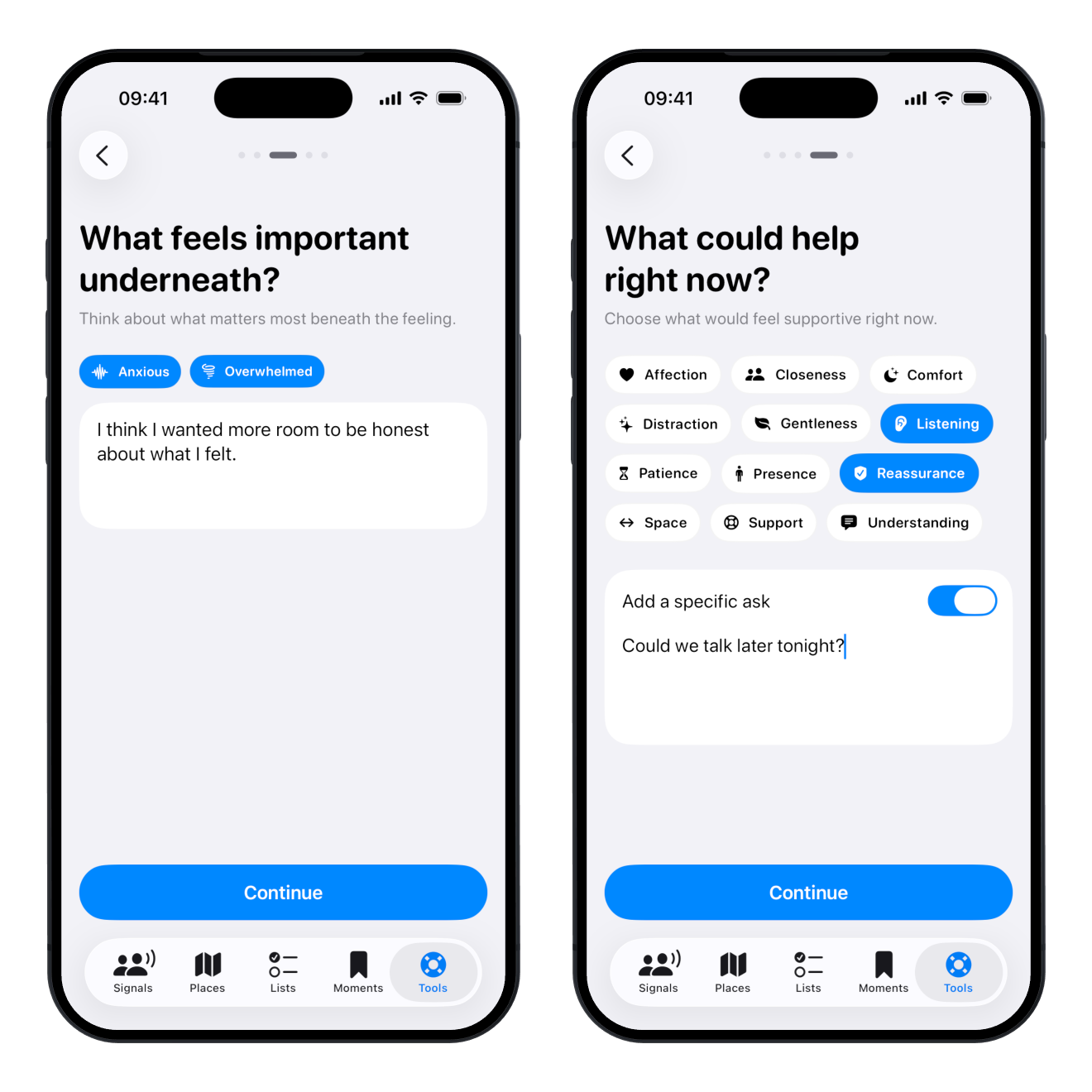
The other tool available at launch is Choices.
This one was inspired by my brother. I remember him telling me how he went on a trip with friends and brought something like a wheel of fortune with them.
The idea was very simple.
Whenever they could not decide, they would put options on the wheel, spin it and accept the result. One person wants one place. Another wants something else. Someone else has a third option. Spin the wheel.
But the most important part was not the random choice itself.
The important part was the agreement that after the option is chosen, there is no more arguing. Everyone is on board. No resentment. No “I told you so”. No dragging the decision forever.
I love that.
Some decisions do not need more discussion. They need a small ritual that makes the choice feel fair enough to move on.
There are a few more tools on the roadmap, but I want to be careful here. Before adding more, I need to understand how people actually use Mudu, which parts feel useful and which parts only sounded good in my head.
Privacy
I already mentioned privacy a few times, but it deserves its own section because Mudu does not really make sense without it.
I felt that if I were the user of this app and knew exactly how everything worked, I should feel at ease. The only way to achieve that was end-to-end encryption. All content in every space is encrypted and only accessible if you have the encryption key.
I will admit that this has some negative effects on UX. During registration, you need to write down your recovery phrase, because without it you could lose access to encrypted content if you get locked out of iCloud. When you invite someone to your space, there is an additional approval step. And some flows are a bit less magical because security needs to be explicit.
But I think this is the right tradeoff. Especially now, when so much software tries to invade your privacy, mine your data and quietly turn personal things into business assets.
Mudu is not that.
Mudu is for partners, families and close friends who want to feel more connected and understood through the small things that shape everyday life. And because those things are personal, they should stay personal.
I use Mudu daily now. That is probably the best sign I have that it became something real, not just another idea sitting in some list.
And I am excited to keep adding things that make my life, and hopefully someone else’s life, better in small but meaningful ways.
If you found this post helpful, or just enjoyed this little corner of the internet, you might also like a few of the other things I make.
- Mudu: a calm space for couples, families, and close friends.
- Decrypto: a cipher puzzle game for curious minds.
No tricks. No weird little traps. Just software made with care by a person who still thinks it can have a soul.